June 22, 2007
Truth vs. Justice? Popular Views on the Truth and Reconciliation Commission and the Special Court For Sierra Leone
Edward Sawyer and Tim Kelsall
Abstract: In Sierra Leone international transitional justice has been pursued via a two-pronged approach. On one, restorative prong, a Truth and Reconciliation Commission has attempted to provide an accurate historical record of the conflict, and to reconcile victims and perpetrators. On the other, retributive prong, an international tribunal is prosecuting individuals for war crimes and crimes against humanity. This strategy has been much debated, but largely at elite levels. Arguably, however, it is at the grassroots where the two institutions face their greatest challenge. To provide a bottom-up view, this article discusses the results of a popular opinion survey. The results show that overall understanding of the Commission and Court are poor and that, partly as a result, the two organs are perceived to have had limited success. In spite of this, most respondents continue to think that they are important to peace in Sierra Leone. Statistical, cultural, methodological, and qualitative interpretations of these findings are discussed. The results provide pointers to the prospects for transitional justice models of this type.
Posted by Editor at 03:23 PM
Minorities within Minorities: Filipino Muslim Women in the Midst of Armed Conflict
Ma. Teresa G. Tuason
C. Dominik Güss
Abstract: The war between the Philippine state and the Muslims in Southern Philippines has spanned three decades and has caused many lives. This is an ongoing local war on numerous fronts: Muslims vs. Catholic religions and cultures; a struggle for political autonomy and governance; and hostilities over ownership of land, sovereignty, and economic resources. The intensity of the trauma of the war on women is heightened because of the context of the war which includes severe poverty, inadequacies in education and health care, instability in government leadership, and graft and corruption in institutions. Women in Southern Philippines suffer the most because they are caught in the crossfire—they are physical and sexual targets of violence on either side of the war; they may be expected to sympathize with either camp but they do not have the power nor the weapon to fight; they carry most of the burden and the responsibility for their family to survive in destitute circumstances; and they constantly evacuate and are displaced from their families, towns, and livelihood. Ongoing and continued peace efforts, dialogues, livelihood projects and support through cooperatives are all part of the healing processes of the women caught in this conflict.
Posted by Editor at 03:20 PM
October 17, 2006
OJPCR 7.1: Youth Negotiating Conflict and Life: A Photo Essay
by Anders Høg Hansen
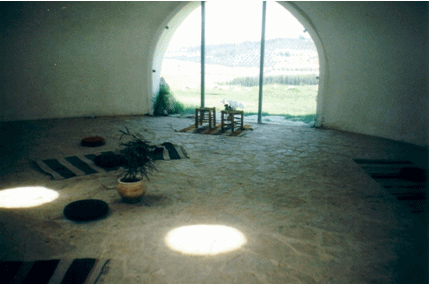
Midways between Tel Aviv and Jerusalem in Israel-Palestine, around the hilly Latrun area, one can find the only Jewish-Arab village within the state of Israel. The place is called Neve Shalom/Wahat al-salam or in English, ‘Oasis of Peace’. The name may confuse visitors. It is a biblical quote used to signal an intention to try peacefully, as one of the residents explained. People who live here know it is not an ‘oasis’. The village has the West Bank border running literally through its alleys, yet it is under Israeli jurisdiction. Spiritually it may be different. It was set up in the early 1970s by Bruno Hussar, a Dominican monk of Jewish extraction born in Egypt who aimed to establish a place where Jews and Arabs could live together. Today, around 50 families, about half Jewish and half Palestinian Arabs with Israeli citizenship live there. You need Israeli citizenship, but as many Arabs in Israel do, you can also call yourself ‘Palestinian’. Hussar, the founder, a Mr. Hybrid par excellence, is buried in the village. This little fragile society is the only one of its kind in the Middle East, which also has a Jewish-Arab board, a bilingual school and an educational centre offering a range of conflict coping projects.
Posted by Editor at 03:23 PM
